
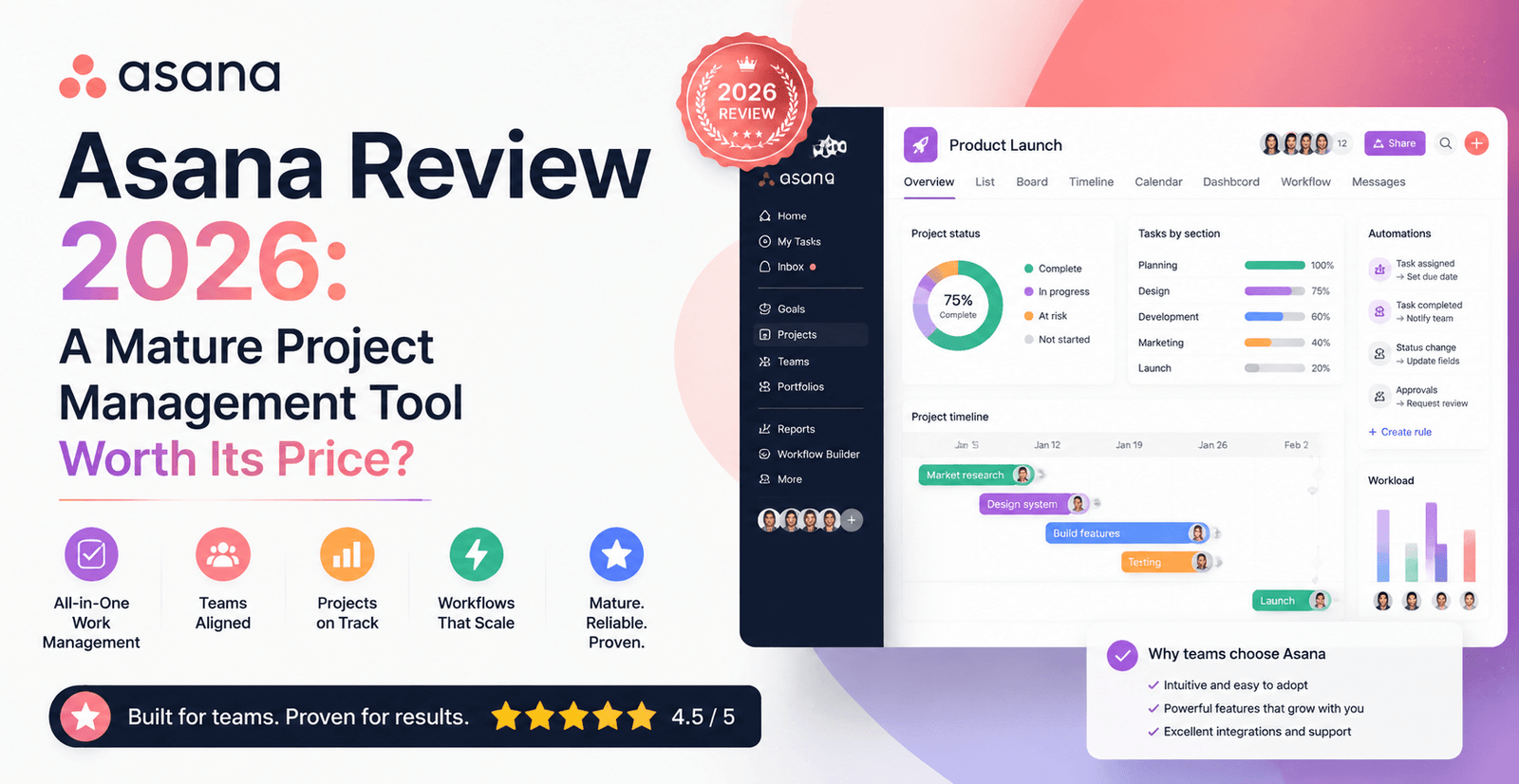
Undertaking administration software program is a crowded class, however Asana has managed to remain close to the highest of it for effectively over a decade by persistently refining relatively than reinventing its core product. We put Asana by its paces throughout checklist, board, timeline, and workload views to see whether or not it nonetheless holds up as a severe choice for groups managing complicated, multi-stage work, and to grasp how its pricing and have depth examine towards a rising subject of well-funded opponents.
What Is Asana?
Asana is a job and mission administration platform designed to assist groups plan, observe, and coordinate work throughout a number of tasks. It helps a number of methods of visualizing the identical underlying knowledge — lists, kanban boards, calendars, and Gantt-style timelines — which lets totally different group members work in whichever view fits them greatest whereas staying synchronized on the identical duties.
Core Options
A number of Undertaking Views
The flexibility to modify between checklist, board, timeline, and calendar views with out dropping any knowledge is one in every of Asana’s most useful options. A mission supervisor would possibly plan dependencies within the timeline view whereas particular person contributors work from a easy checklist or kanban board, all whereas taking a look at precisely the identical set of duties. This flexibility reduces the friction of forcing a complete group into one inflexible method of working.
Automation with Guidelines
Asana’s Guidelines characteristic permits groups to automate repetitive actions, similar to reassigning a job when its standing adjustments or notifying a channel when a deadline approaches. Establishing guidelines requires no coding and is approachable even for non-technical mission managers, although constructing genuinely complicated, multi-condition automations nonetheless takes some trial and error.
Workload and Useful resource Administration
The Workload view offers managers a visible sense of how a lot work is assigned to every group member, which is invaluable for recognizing overallocation earlier than it turns into a burnout downside. This characteristic is without doubt one of the clearer differentiators between Asana and lighter-weight job managers that solely observe completion standing with out accounting for capability.
Objectives and Portfolios
Asana’s Objectives characteristic connects day-to-day job work to higher-level firm aims, letting management observe progress towards strategic priorities with out digging by particular person tasks. Portfolios present an identical rollup view throughout a number of associated tasks. Collectively, these options make Asana really feel much less like a easy to-do checklist and extra like a real operational administration software for mid-sized and bigger organizations.
AI Options
Asana’s AI instruments now help with drafting job descriptions, summarizing mission standing for stakeholder updates, and flagging duties that seem susceptible to lacking their deadline primarily based on historic patterns. The chance-flagging characteristic was a standout in our testing, catching a handful of quietly slipping duties which may in any other case have gone unnoticed till a lot nearer to the deadline.
Design and Usability
Asana’s interface strikes an inexpensive stability between energy and ease, although the sheer variety of options and settings will be overwhelming for groups migrating from a a lot easier software. New customers profit considerably from Asana’s onboarding templates and guided setup, and most groups we noticed had been productively utilizing the core options inside their first week, even when superior automation took longer to grasp.
Efficiency and Reliability
Efficiency has been persistently strong in our testing, with quick load instances even on tasks containing a whole lot of duties. Cellular apps are succesful, although as with most mission administration instruments, the desktop expertise stays noticeably extra full-featured than the cell model, notably for establishing automations or constructing complicated portfolio views.
Pricing
Asana’s free tier covers fundamental job and mission monitoring for very small groups, however superior options like Timeline, Workload, and Guidelines require a paid improve. Pricing climbs meaningfully on the larger tiers wanted for Objectives and Portfolios, which may make Asana one of many pricier choices for organizations that need its full characteristic set relatively than simply fundamental job monitoring. Smaller groups that solely want lists and boards might discover the associated fee more durable to justify in comparison with lighter options, and it is value trialing the free tier completely earlier than committing to a paid plan to verify the particular superior options are literally wanted to your group’s workflow relatively than merely accessible.
Ideas for Getting the Most Out of Asana
Groups migrating from a less complicated software are likely to do greatest by rolling out Asana’s options progressively relatively than enabling Guidelines, Objectives, and Portfolios unexpectedly. Begin with fundamental job and mission monitoring for the primary few weeks, let the group get snug with the core checklist and board views, and solely then introduce automation and higher-level rollups as soon as the basics really feel pure. It is also value designating a single mission template as the usual start line for brand new work, since constant mission construction makes the Workload and Portfolio views way more helpful than they’re in a workspace the place each mission supervisor units issues up in a different way. Lastly, reviewing the AI risk-flagging ideas throughout a daily weekly check-in, relatively than solely reacting to them advert hoc, tends to catch slipping deadlines earlier and extra reliably.
Professionals
- A number of synchronized mission views go well with totally different working kinds
- Sturdy workload and capability administration instruments
- Objectives and Portfolios join day by day work to strategic priorities
- Helpful AI-driven threat flagging for at-risk duties
- Dependable efficiency even on giant, complicated tasks
Cons
- Full characteristic set is dear relative to easier opponents
- Can really feel overwhelming for groups new to structured mission administration
- Superior automation requires a studying curve
- Cellular app lacks a number of the desktop’s extra superior performance
- Key options like Timeline and Workload are locked behind paid tiers
Safety and Administrative Controls
Asana’s security measures scale meaningfully with plan tier, and bigger organizations will discover the executive controls on enterprise plans genuinely sturdy, together with knowledge governance insurance policies, SAML-based single sign-on, and detailed exercise logs for compliance functions. Smaller groups on decrease tiers get an inexpensive baseline of permission controls on the mission and workspace degree, sufficient to maintain delicate tasks restricted to the individuals who want them, although a number of the extra superior governance instruments are reserved for higher-priced plans, which is value factoring into a complete price comparability for regulated industries.
Buyer Help Expertise
Asana’s assist middle is detailed and well-structured, with guided setup flows that stroll new admins by configuring their first few tasks. For on a regular basis questions, this documentation is normally enough. After we contacted help with a query about configuring a multi-condition Rule, the response was thorough and included a working instance tailor-made to our state of affairs, arriving inside a couple of day. Enterprise prospects obtain a devoted buyer success contact, which bigger organizations managing complicated rollouts will doubtless discover precious through the preliminary implementation interval.
How Asana Compares to Options
Monday.com is Asana’s closest competitor by way of total characteristic breadth, and the selection between the 2 typically comes all the way down to interface desire as a lot as performance, since each supply comparable views and automation capabilities. ClickUp positions itself as a lower-cost various with a good bigger characteristic set, although that breadth can come at the price of a extra cluttered interface. Trello stays a less complicated, cheaper choice for groups that solely want fundamental kanban boards with out Asana’s Workload, Objectives, or Portfolio options. For organizations that particularly want to attach day by day job execution to higher-level strategic targets, Asana’s Objectives characteristic stays one of many extra mature implementations of that idea amongst mainstream mission administration instruments.
Cellular Expertise
Asana’s cell apps cowl the core performance effectively, together with job creation, commenting, and standing updates, making it real looking to remain on prime of a mission whereas away from a desk. Nevertheless, establishing new Guidelines, configuring Portfolios, or constructing out an in depth Timeline view is significantly extra cumbersome on a small display screen, and most mission managers we spoke with described cell as primarily a software for checking in and responding rapidly relatively than doing substantial setup work.
Who Ought to Use Asana?
Asana is greatest suited to mid-sized to giant groups managing a number of concurrent tasks who want visibility into each particular person job standing and higher-level strategic progress. Advertising and marketing departments, operations groups, and cross-functional teams juggling a number of initiatives without delay are likely to get probably the most worth from its Workload and Portfolio options. Very small groups with easy, single-project wants might discover a lighter and cheaper software enough.
Businesses managing work throughout many exterior shoppers additionally have a tendency to profit disproportionately from Asana’s Portfolio view, because it offers a single rollup of standing throughout dozens of in any other case unrelated tasks with out requiring anybody to open every one individually. Equally, operations and HR groups operating recurring, process-driven work, similar to worker onboarding or vendor approvals, typically get sturdy worth from Asana’s Guidelines characteristic as soon as the preliminary automation is constructed, because it removes a significant quantity of guide coordination that might in any other case fall on a single group member to trace by hand.
Remaining Verdict
Asana has matured right into a genuinely complete mission administration platform, and its Workload, Objectives, and AI risk-flagging options set it aside from easier job trackers. The worth tag for its full capabilities is actual, and smaller groups ought to actually assess whether or not they want that depth earlier than committing. However for organizations managing complicated, multi-project operations, Asana stays one of many strongest choices available on the market.





Leave a Reply